
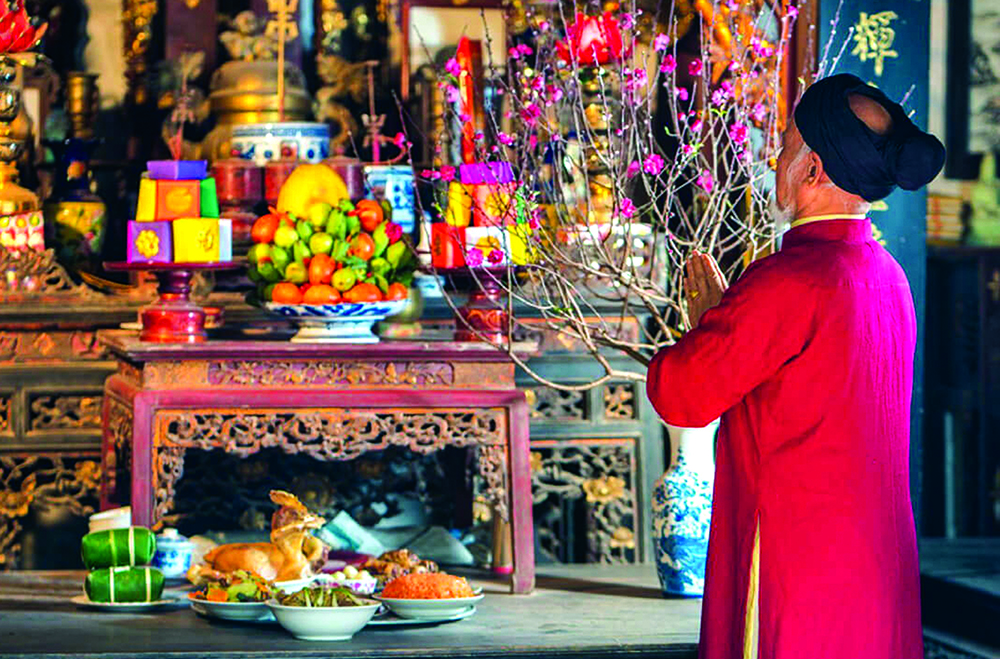
Step into a Vietnamese home and your eye may be drawn first to the television, the family photographs, or the furniture arranged around a sitting room. Look a little longer, however, and another part of the household begins to reveal itself. Somewhere in a place of importance, often raised above ordinary objects, there may be an altar. On it are photographs of people who have died, bowls for incense, flowers, fruit, small cups of tea or water, perhaps a plate of food. In wealthier homes it may be carved from dark wood and occupy an entire wall. In a small apartment it may be much simpler. A shopkeeper may have one behind the counter. A restaurant may have one tucked above a refrigerator. Even a modern office can contain a quiet corner where incense is burned.
For someone arriving from a society in which the dead are mostly encountered in cemeteries, churches, memorials or family albums, the presence of such altars can be striking. They suggest something fundamental about Vietnamese ideas of family. Death removes a person from everyday life, but it does not necessarily remove that person from the family.
Across Vietnam, remembering ancestors remains one of the most persistent forms of ritual life. It can coexist with Buddhism, Christianity, local religious practices, modern education, apartment living and a highly technological economy. It may be performed with elaborate ceremonies or with little more than a few sticks of incense placed before a photograph. Scholars studying Vietnamese communities have emphasized that what is commonly translated into English as “ancestor worship” is not simply a matter of believing in supernatural beings. It also belongs to the moral and social worlds of family obligation, memory and gratitude. One anthropological study of villages in the Red River Delta describes the practice through a Vietnamese idea that can be understood as remembering the moral debt owed to parents and grandparents.
That is why an ancestral altar can tell a visitor more about Vietnam than its size suggests.
The Family Does Not End With the Living
The English phrase “ancestor worship” can be misleading.
The word worship may suggest the kind of devotion offered to a god. Vietnamese practices are more varied than that. Families may pray for protection or good fortune, but ancestral rites can also be acts of remembrance, filial respect and continued care for people who once belonged to the household. The boundary between religion, family custom and morality is not always drawn in the same place that it would be in a modern Western religious framework.
A useful way to understand the practice is to begin with a relationship familiar almost everywhere. Parents raise children. Grandparents help preserve a family’s stories, property and identity. Earlier generations endured hardships and created the conditions into which later generations were born. The living therefore inherit more than genes. They inherit a debt.
Vietnamese culture has long expressed that obligation through ideas of hiếu, usually translated as filial piety. Confucian philosophy strengthened and formalized such ideas over centuries, particularly among educated and elite families, but the ritual relationship between descendants and the dead cannot be reduced to Confucian doctrine alone. Vietnamese religious life historically absorbed and combined local beliefs with Buddhism, Confucianism and Taoist traditions rather than requiring each to exist in complete isolation. UNESCO research on Vietnam’s cultural diversity has similarly noted the way these traditions became embedded in village festivals and ancestral cults.
For many families, then, the altar represents continuity. The people whose photographs rest there may no longer sit down for dinner, but they have not become irrelevant. They are remembered when a child is born, when a son or daughter marries, when a family moves house, when examinations are approaching, when a business is opened, and particularly when the household gathers for important festivals.
The family extends backward.
The Altar at the Center of the House
There is no single ancestral altar used by every Vietnamese family. Regional traditions differ, religious affiliations differ, and the amount of space and money available to a household obviously matters. Yet several features recur often enough to be recognizable.
Incense is perhaps the most visible. Lighting incense creates a ritual moment and is commonly associated with remembrance and communication with the sacred or deceased. Flowers and fresh fruit may be placed on the altar. Tea, water or alcohol may be offered. During important ceremonies, cooked dishes can be prepared for the ancestors before the living family begins its own meal.
Photographs of deceased parents and grandparents are common in many households. Older family altars may instead use tablets, inscriptions or genealogical information. Some homes maintain separate spaces connected to Buddhism or other religious traditions, while others combine different forms of devotion in ways that would be difficult to classify neatly.
Foreign visitors sometimes assume that food placed before an altar is being symbolically discarded. It usually is not. Offerings can later be shared among members of the family. The important part is that the ancestors are honored first.
Official guidance for travelers in Vietnam reflects the seriousness with which these household spaces are treated. Vietnam’s tourism authority advises visitors not to block an altar or casually place possessions in front of it, noting that altars in homes and businesses are places of regular worship and respect for ancestors and spirits.
The practical lesson is uncomplicated. If you are invited into a Vietnamese home, do not treat the altar as furniture. Avoid leaning against it or rearranging its objects. If your host burns incense or makes an offering, allow the ritual to proceed without turning it immediately into a photographic opportunity.
What appears to be a small corner of the room may be one of its most important spaces.
The Day the Family Returns
Every family accumulates dates.
Birthdays are among the most important dates in many Western households. In Vietnam, the anniversary of a death can carry comparable weight. Known as giỗ, the death anniversary of a parent, grandparent or another significant ancestor may bring relatives together year after year.
In Hội An, anthropological research has described đám giỗ, ancestor commemoration ceremonies centered around death anniversaries, as among the town’s most frequently celebrated family rituals. Practices vary greatly by household and region, but a typical commemoration can involve cleaning the altar, preparing incense and offerings, cooking a substantial meal and inviting relatives to return home.
From the outside, a giỗ can look remarkably like a family party. There is conversation. Children run around. Food arrives in large quantities. Relatives who have not seen one another recently exchange news. Yet at the center of the gathering is someone who is absent.
That absence gives the gathering its structure.
Before the family eats, offerings may be made at the altar. Incense is lit. Family members may bow or stand quietly before the ancestor. Depending on the household, prayers or formal ritual words may be spoken. Once the ceremony is completed, the food becomes part of the meal for the living.
The result is something more complex than mourning. A death anniversary can be cheerful, solemn, noisy, exhausting and affectionate at the same time. It keeps alive the memory of an individual, but it also repeatedly reconstructs the relationships among the living descendants.
A relative may travel hundreds of kilometers not simply because an ancestor needs incense, but because the anniversary is one of the occasions when the family becomes physically whole again.
At Tết, the Dead Come Home Too
No time of year reveals the relationship between Vietnamese families and their ancestors more clearly than Tết, the Lunar New Year.
For outsiders, Tết is often represented through red decorations, flowers, lucky money, bánh chưng, fireworks and family meals. All of these are part of the holiday, but beneath the celebrations lies an important ritual idea. The new year is not entered by the living family alone.
Vietnam’s official tourism site describes Tết as a time when families return to their hometowns, visit the graves of deceased relatives and prepare ancestral altars with flowers, incense and offerings. Academic research on urban Vietnamese Tết similarly notes extensive worship around the home and the ritual invitation of ancestors to join the living during the festival period.
In the days before Tết, many families clean graves and tend ancestral spaces. Household altars are refreshed. Food and flowers are prepared. On the final days of the old lunar year and the opening days of the new one, offerings may be made to welcome ancestors back into the family home.
This is why descriptions of Tết simply as “Vietnamese New Year” miss something essential. It is simultaneously a celebration of renewal and an act of return.
Children come home from distant cities. Adults travel back to their native villages. Family members who live abroad may make special efforts to return. And through ritual, those who can no longer travel are brought back as well.
The geography of the Vietnamese family briefly contracts around the ancestral home.
This helps explain why Tết traffic can be so intense, why transportation becomes crowded, and why the holiday can carry emotional weight far beyond parties and public festivities. For many Vietnamese people, going home is not merely one possible way to celebrate Tết.
Going home is the celebration.
Are Vietnamese Ancestors Gods?
Foreign visitors often ask a seemingly straightforward question: do Vietnamese people believe their ancestors are gods?
Usually, that is the wrong question.
Vietnamese religious life has never been organized around a simple divide between gods and non-gods. Different kinds of sacred beings can coexist within the same cultural world. Buddhists may venerate Buddhas and bodhisattvas. Communities may honor village guardian spirits. Historical heroes can become the focus of temples and festivals. Families maintain relationships with their dead. The categories overlap without necessarily becoming identical.
An ancestor does not need to be a god in order to receive incense.
Some families may ask ancestors for protection, health or success. Others emphasize gratitude and remembrance more strongly. Members of the same family may even understand the same ritual differently. One person may believe that the deceased literally receives the offering. Another may see the ceremony primarily as an expression of respect. A third may participate because maintaining family traditions is important even if they are uncertain about the spiritual explanation.
All can stand before the same altar.
This flexibility is one reason ancestor veneration has proved so durable. It does not always require a formal creed. There is no universally binding Vietnamese doctrine explaining exactly where the ancestors reside, precisely how offerings reach them, or what every descendant must believe.
The ritual can survive disagreement about theology because its social meaning remains powerful.
Buddhism, Confucianism and a Much Older Religious World
When foreigners encounter ancestral rites in Vietnam, they sometimes label them Buddhist. The association is understandable because Buddhist temples frequently play important roles in funerals and memorial practices, and many Vietnamese families consider themselves influenced by Buddhism. But ancestor veneration is not simply a branch of Buddhism.
Confucianism contributed another important layer. For centuries, Vietnamese states adopted Confucian political and ethical ideas from China. Among these was an intense emphasis on filial obligation, genealogical continuity and proper ritual behavior within the family. Patrilineal family organization became particularly important in many communities and was reinforced by Confucian social ideals. Historical research on Vietnamese village formation has documented the influence of Confucian patrilineal kinship in organizing lineage institutions and property.
Yet Vietnamese ritual life also retained much older local ideas involving spirits, the dead, sacred places and relationships between visible and invisible worlds. Buddhism, Confucianism and Taoist traditions entered this landscape over many centuries and were adapted rather than simply copied.
Trying to assign every incense stick to a single religion therefore misses the way Vietnamese culture developed.
A household may contain an ancestral altar while members of the family visit a Buddhist pagoda. They may consult a geomancer for a burial. They may participate in the festival of a village deity. They may describe themselves on an official form as having no religion.
From the perspective of a visitor accustomed to exclusive religious categories, this can appear contradictory. Within Vietnamese cultural history, it is considerably less so.
From Family Ancestors to the Ancestors of a Nation
The logic of ancestry does not stop at the door of the household.
Vietnamese tradition remembers the Hùng Kings as the ancient founding rulers of the Vietnamese people. Whatever historians may conclude about the precise relationship between these legendary rulers and the archaeological record, their role in Vietnamese cultural memory is enormous.
Every year, large numbers of people travel to the Hùng temple complex at Nghĩa Lĩnh Mountain in Phú Thọ to commemorate them. UNESCO, which added the Worship of the Hùng Kings in Phú Thọ to its Representative List of the Intangible Cultural Heritage of Humanity in 2012, describes millions of people participating annually in ceremonies honoring these ancestral rulers and praying for health, prosperity, favorable weather and good harvests.
Here the language of family becomes national.
Vietnamese people commonly refer to themselves through the idea of shared descent expressed in the legendary story of Lạc Long Quân and Âu Cơ, the parents of one hundred children from whom the Vietnamese are said to descend. Whether approached as myth, cultural memory or symbolism, the story imagines the nation itself as an extended family.
The Hùng Kings are therefore more than ancient monarchs. They function as ancestors of the community.
This helps explain why ancestor veneration in Vietnam cannot be understood only as private religion. It provides a language through which families remember themselves, but also one through which villages, lineages and even the nation can imagine continuity with the past.
The dead bind groups together.
Why There Is an Altar Behind the Cash Register
Visitors quickly discover that ancestral and spiritual altars do not remain safely inside traditional houses.
Look behind the counter of a small shop and you may find incense. Walk into a family restaurant and there may be an altar overlooking the dining room. A mechanic, salon owner or business family may maintain ritual space on the premises. Vietnam’s official guidance to travelers specifically notes the presence of altars in both homes and businesses.
Not every altar in a business is necessarily devoted to family ancestors. Vietnamese popular religious life includes other beings connected with wealth, land and protection, and arrangements vary considerably. Nevertheless, the widespread presence of altars reveals something important about the relationship between religion and everyday life.
The sacred is not necessarily separated from commerce.
A person may make an offering in the same room where invoices are printed, customers eat lunch or motorbikes are repaired. That does not make the ritual less serious. It means that the distinctions between sacred space and ordinary space are drawn differently.
For travelers, this is worth remembering because an altar placed low to the ground or in a busy commercial environment can easily be mistaken for decoration. Stepping over offerings, placing bags against an altar, or standing directly in front of it for an extended period can be discourteous.
Observe before occupying the space.
It is a rule that works surprisingly well in Vietnam.
Paper Houses, Paper Money and Gifts for Another World
Some Vietnamese ancestral and funerary rituals involve burning votive paper objects, known generally as hàng mã. Traditional offerings have long included paper money and representations of clothing or household goods. Modern examples can take surprisingly contemporary forms.
Researchers studying Vietnamese ritual economies have documented paper replicas of consumer objects, including televisions, phones and other modern possessions, produced for use in offerings to the dead.
To foreign observers, a paper smartphone intended for a deceased relative may initially seem humorous. From within the ritual logic, however, the object expresses a very old idea in a new material form. The dead continue to require care. If the living world changes, the objects through which care is expressed can change with it.
Tradition is rarely preserved by remaining exactly the same.
This is one of the most fascinating features of ancestral practice in modern Vietnam. The architecture of the family may change from a village compound to a high-rise apartment. Photographs replace older forms of ancestral representation. Offerings incorporate consumer products that did not exist a generation earlier. Funeral practices adapt to urban environments. Some families simplify ceremonies because children live far away.
Yet the underlying relationship can continue.
The ancestors move into modernity with everyone else.
What Happens When the Family Moves to an Apartment?
Vietnam has urbanized rapidly, and millions of people now live far from the villages or neighborhoods where earlier generations of their families were based. Young adults move to Hanoi, Ho Chi Minh City, Đà Nẵng and other cities for university and work. Apartments replace large multigenerational homes. Vietnamese families are also spread across Australia, North America, Europe and other parts of Asia.
Practices inevitably adjust.
An elaborate wooden altar that once occupied the central room of a large house may become a small wall-mounted altar in a city apartment. A death anniversary once attended by dozens of relatives may become a smaller gathering. Family members living overseas may participate by phone or return only for especially important occasions.
Even practices surrounding burial are changing. Research on contemporary Vietnamese cities has noted increasing acceptance of cremation and new arrangements for keeping remains, including placement in pagodas and other religious spaces, changes that interact with older concepts of ancestor remembrance.
Such developments occasionally produce debates about whether traditions are disappearing. But disappearance is not the only possible interpretation.
Traditions can shrink in physical size while retaining emotional significance.
A family may have less space for an altar but still maintain one. A young Vietnamese person may spend most of the year in another city but return for the death anniversary of a grandparent. A family abroad may prepare ancestral offerings with ingredients available locally. The form changes because the conditions of life change.
Continuity does not require perfect reproduction.
Ancestors After Revolution
Vietnam’s twentieth century created particularly complicated relationships with ritual.
Revolution, war, socialist transformation and economic change all altered family and religious practices. Some traditional rituals were criticized or restricted as wasteful, superstitious or connected to older social hierarchies. Yet from the late twentieth century onward, ritual activity became increasingly visible again.
Anthropologists studying Vietnam during the Đổi Mới era have documented a broad revival of ancestral, communal and local religious practices. Research in Hanoi, for example, has described the flourishing of village-level ceremonies, pilgrimages and rituals in the post-revolutionary period. Another influential study of Red River Delta communities argues that ancestral remembrance gained renewed public expression during this period and should be understood not merely as religion but as something connected to moral debt, social relationships and local identity.
This revival did not simply restore an untouched premodern past.
Modern Vietnam remembers its dead in new political ways as well. Families commemorate relatives lost in twentieth-century wars, while the state maintains cemeteries and memorials for those officially recognized as revolutionary martyrs. Public commemoration and private ancestral memory can intersect.
The result is a landscape filled with many forms of remembrance.
A village may contain an ancestral hall, a Buddhist pagoda, a monument to war dead and a cemetery used by local families. Each addresses the past differently, yet all make visible a society in which the dead remain socially important.
What Should a Visitor Do?
If you are invited to a Vietnamese home during an ancestral ceremony, the safest approach is neither to imitate everything nor to retreat nervously to a corner.
Watch your host.
You may be invited to light incense. If so, accept if you feel comfortable. No one expects a foreign visitor to understand every movement. Hold the incense respectfully and follow the example given to you. If participation conflicts with your own religious beliefs, a polite refusal is generally better than performing a ritual insincerely.
Photography should be approached with sensitivity. An elaborate altar may be visually beautiful, but beauty does not make it public property. Ask before photographing a household altar, a funeral, a grave ceremony or people actively praying.
During a death anniversary meal, remember that what appears to be a banquet may have a ceremonial sequence. Wait until your hosts indicate that it is time to eat. Do not touch offerings before they have been removed from the altar or offered to guests.
At graves and sacred sites, avoid stepping over ritual objects or treating tombs as convenient places to sit.
None of these practices requires specialized knowledge. They require attention.
Vietnamese families are perfectly aware that foreign visitors may not understand local rituals. Genuine respect matters far more than technical perfection.
The Ancestors Are Also Memory
It is tempting to explain ancestor veneration entirely through belief in spirits. Doing so would make the practice easier to categorize, but it would make Vietnamese family life harder to understand.
An altar preserves names.
A death anniversary preserves stories.
A family gathering preserves relationships between cousins who might otherwise drift apart.
A grave connects a person living in an apartment tower in Ho Chi Minh City with a village from which their grandparents came.
An annual journey to Phú Thọ connects millions of people with legendary rulers imagined as common ancestors. UNESCO describes the Hùng Kings tradition not merely as ceremony but as an expression of spiritual solidarity and national identity.
This is why the practice can continue even among people whose beliefs about the supernatural are uncertain. The ancestor is at once a spirit, a memory, a moral example, a piece of family history and a reason for the living to come together.
Different people emphasize different parts.
A House With More Than One Generation
Return to the Vietnamese home where we began.
Perhaps it is no longer an old house. Imagine instead a modern apartment several floors above a busy street. There is a refrigerator covered with magnets, a Wi-Fi router blinking beside the television, children’s schoolbooks on the table and motorbike helmets near the door.
Against one wall is the altar.
On an ordinary evening it may attract little attention. Then the anniversary of a grandfather’s death approaches. Fruit appears. Flowers are arranged. Someone buys incense. Food is prepared earlier than usual. A daughter returns from another district. A son calls from overseas. An elderly relative tells a story the younger members of the family have heard before but listen to again.
The grandfather has been dead for twenty years.
Still, because of him, everyone is here.
That may be the simplest way to understand why ancestors still matter in Vietnam. The ritual is concerned with the dead, but its effects are among the living. It teaches descendants where they belong, reminds them that their lives began before their own birth, and creates moments when a family scattered across cities and generations becomes visible to itself again.
In many cultures, the past is imagined as something behind us.
In a Vietnamese home, it may be standing quietly in the same room.