
A bowl of phở is easy to recognize. So is a bánh mì, a plate of fresh spring rolls, or a glass of dark coffee sweetened with condensed milk. These foods have become shorthand for Vietnam abroad, appearing on restaurant menus from Melbourne to Montreal. Yet none of them, taken alone, explains Vietnamese food particularly well. Phở is only one noodle soup among many. Bánh mì is one branch of a much larger bread culture. Spring rolls change names, fillings, wrappers, and cooking methods as one moves from region to region. Even fish sauce, perhaps the ingredient most closely associated with Vietnamese cooking, does not create Vietnamese flavor by itself.
What makes Vietnamese food Vietnamese is not a fixed collection of dishes. It is a way of composing meals, balancing tastes, using fresh ingredients, sharing food, adapting foreign influences, and responding to the geography of a country that stretches for more than a thousand miles from north to south.
Vietnamese cuisine is often described with words such as fresh, light, fragrant, or balanced. These descriptions are not wrong, but they can become clichés if they are allowed to stand without explanation. Vietnamese food can also be rich, fatty, fermented, smoky, intensely salty, sweet, bitter, pungent, or deeply savory. A bowl of bún bò Huế does not taste “light” in the same way as a plate of gỏi cuốn. A pot of braised pork in coconut water belongs to a different sensory world from Hanoi’s bún thang. The better question is not what Vietnamese food tastes like in general, but what principles allow such different foods to still feel recognizably Vietnamese.
The answer begins with rice.
Rice Is More Than a Side Dish
For much of Vietnamese history, rice has been more than a staple food. It has been part of the structure of everyday life.
Wet-rice agriculture shaped settlement patterns in the Red River and Mekong deltas, organized labor around irrigation and seasonal cycles, and influenced the rhythms of village life. Rice appears in ordinary meals, ceremonial offerings, festivals, family rituals, and expressions of hospitality. It can be steamed, turned into noodles, ground into flour, fermented, puffed, wrapped, pressed, or transformed into cakes eaten at particular times of the year.
The Vietnamese word cơm is revealing. It can mean cooked rice, but it can also refer more broadly to a meal. To ask whether someone has eaten rice can, depending on context, function much like asking whether they have eaten at all.
This does not mean every Vietnamese meal is centered on a bowl of plain rice. Noodles are equally important in many settings, especially at breakfast and lunch. But even noodles reveal the centrality of rice. Phở, bún, bánh hỏi, bánh cuốn, hủ tiếu and many other staples depend on rice flour or rice-derived forms. Vietnamese cuisine repeatedly takes the same grain and changes its texture, shape, thickness and purpose.
A grain can become a bowl of steaming rice at dinner, a delicate sheet wrapped around pork in the morning, a thin noodle floating in broth at noon, or a sticky cake offered to ancestors during Tết.
Few ingredients demonstrate Vietnamese culinary imagination more clearly.
A Vietnamese Meal Is Built Around Relationships
Western restaurant culture often presents food as an individual possession. Each diner orders a separate plate. The plate contains a complete composition. Protein, vegetables, starch and sauce are arranged for one person.
A traditional Vietnamese family meal is structured differently.
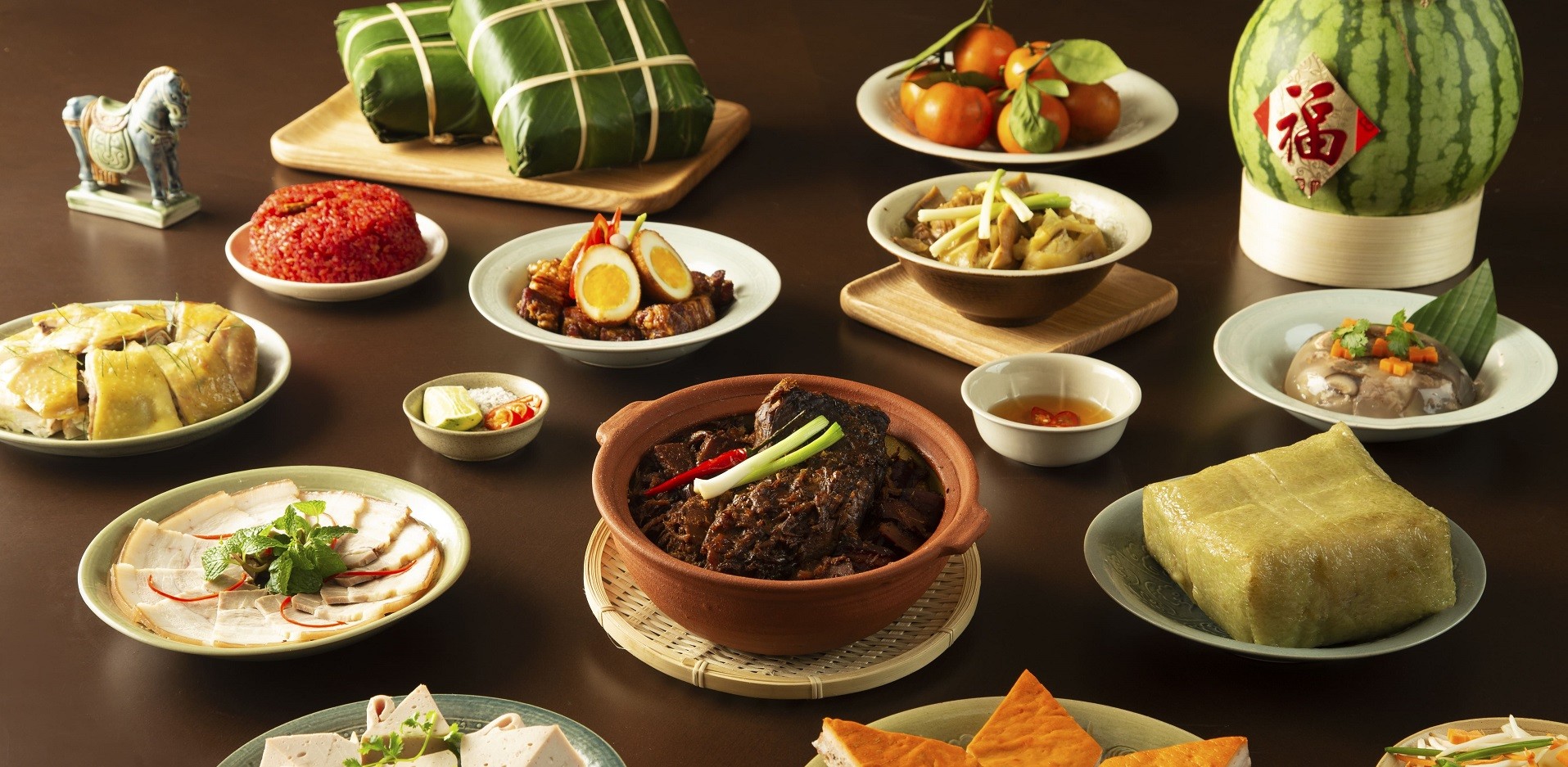
Several dishes are placed in the middle of the table and shared. There may be a pot of soup, a plate of stir-fried vegetables, fish or meat, something braised, perhaps pickled vegetables or fresh herbs, and a small bowl of dipping sauce. Each person has an individual bowl of rice, but the rest of the meal belongs to the table.
This changes how food is experienced.
A bite of rice may be followed by fish dipped in nước mắm, then greens, then a spoonful of soup. A salty dish can be balanced by plain rice. A rich braise is moderated by vegetables. A sour soup interrupts the heaviness of meat. The meal is not designed so that every single dish contains every desirable flavor. Balance is created across the table.
This may be one of the most important differences between Vietnamese food as it is eaten at home and Vietnamese food as it is often represented abroad.
The unit of Vietnamese cuisine is frequently not the dish.
It is the meal.
The composition matters collectively. Something salty calls for something mild. Something fried benefits from herbs or vegetables. Something fatty may be eaten with pickles. Soup refreshes the palate. Rice absorbs sauces and carries strong flavors. The meal makes sense because the dishes interact.
Eating this way also turns dinner into a social arrangement. People reach toward the same plates, offer food to children or elders, refill bowls, and notice who has eaten what. Food circulates through relationships.
The architecture of the table reflects the architecture of the family.
Fish Sauce Is a Foundation, Not a Flavor Trick
If rice provides the structure of many Vietnamese meals, fish sauce supplies one of their deepest sources of savory flavor.
Nước mắm is made by fermenting fish, traditionally anchovies or other small fish, with salt. The resulting liquid can smell formidable to someone encountering it for the first time, but in Vietnamese cooking it performs a role comparable to salt, seasoning stock, and fermented condiments elsewhere in Asia.
Fish sauce is not always supposed to taste obviously like fish.
A small amount can deepen a broth. It seasons braised dishes. It enters marinades, dipping sauces, stir-fries and soups. Mixed with water, sugar, lime or vinegar, garlic, and chili, it becomes a dipping sauce whose proportions vary from household to household and dish to dish.
Its importance illustrates a broader characteristic of Vietnamese cooking: fermentation is not an exotic edge case but part of the culinary foundation.
Shrimp paste, fermented fish, pickled vegetables, fermented tofu, rice wine and other preserved ingredients appear throughout regional cuisines. Some are mild. Others announce themselves before they reach the table. Vietnamese food can be remarkably delicate, but it is not afraid of strong smells.
This is one reason reducing Vietnamese cuisine to “fresh herbs and clean flavors” gives only half the story.
Freshness often works precisely because it is paired with fermentation.
A pungent sauce meets raw herbs. Fatty pork meets pickled vegetables. Grilled meat meets sour fruit. Richness becomes more vivid because something sharp stands beside it.
Vietnamese flavor is often created through tension rather than simplicity.
Herbs Are Ingredients, Not Decoration
A plate of herbs beside a Vietnamese meal can puzzle first-time visitors.
Are they garnish? Should they be eaten? All of them? At once?
Usually, the answer is that they are part of the meal.
Mint, Thai basil, perilla, Vietnamese coriander, fish mint, sawtooth coriander, lettuce, bean sprouts and other greens can appear alongside noodles, grilled meats, pancakes and soups. Which herbs are served depends on the dish and region. Diners add them according to taste, changing the aroma and texture of each bite.
This gives Vietnamese food a degree of participation.
The cook prepares the dish, but the diner often completes it.
A bowl of phở may arrive with herbs, lime and chili. Bánh xèo may be wrapped in leaves before being dipped into sauce. Grilled pork may be eaten with noodles, lettuce and herbs, creating a different combination in each mouthful. A rice-paper roll is assembled at the table.
The meal is therefore not always finished when it leaves the kitchen.
This abundance of raw or lightly cooked greens also produces the sense of freshness that foreign diners often associate with Vietnamese cuisine. But freshness is not simply aesthetic. It changes strong flavors. Herbs cut through fat, add bitterness, fragrance or cooling notes, and create textural contrast with fried or grilled foods.
One could remove the herbs and still technically recognize many Vietnamese dishes.
But something essential would be missing.
Balance Does Not Mean Everything Is Mild
Vietnamese food is frequently explained through the concept of balance: hot and cool, sweet and sour, salty and fresh, soft and crisp. There is truth in this, but the idea can easily become romanticized into a claim that every Vietnamese dish follows an ancient philosophical formula.
Actual cooking is messier and more interesting.
Vietnamese cooks balance food through habit, taste, family preference, season, region, and ingredient availability. A sour broth may need sugar. A dipping sauce may need lime. A rich pork dish needs pickled mustard greens. A bowl of noodles may be incomplete without chili or fresh herbs.
The important point is that contrast matters.
Texture is especially important. Vietnamese meals frequently combine soft noodles with crunchy vegetables, crisp fried surfaces with tender fillings, chewy rice cakes with fresh herbs, or smooth broth with raw bean sprouts. A dish can feel incomplete if all its elements have the same texture.
Temperature also creates contrast. Hot broth meets cool herbs. Fresh rolls may be dipped into warm or intensely flavored sauce. Grilled meat arrives smoking while raw vegetables remain crisp.
Western descriptions of cuisine often focus first on flavor. Vietnamese eating makes just as much sense when thought of through texture, temperature and aroma.
A good mouthful is rarely one-dimensional.
Vietnamese Cuisine Changes as You Travel
One of the quickest ways to misunderstand Vietnamese food is to treat it as a single national menu.
Vietnam is long, geographically fragmented, and historically regional. Mountains divide areas from one another. Climate changes sharply between north and south. Different regions developed their own courts, ports, agricultural systems, trading connections and culinary preferences.
Northern Vietnamese cooking is often described as more restrained in sweetness and chili than southern food. Hanoi has developed some of the country’s most famous dishes, including phở, bún chả and chả cá. Broths may appear visually simple while depending on careful seasoning and long preparation. Fresh herbs remain important, but some northern dishes use them more selectively than southern equivalents.
Central Vietnam presents another culinary world. Huế, the former imperial capital of the Nguyễn dynasty, is famous for small, carefully composed dishes associated both with royal cuisine and with the cooking of ordinary households. The broader central region is also known for stronger use of chili, fermented sauces and bold seasoning. Dishes such as bún bò Huế can be aromatic, spicy and deeply savory, while foods like bánh bèo, bánh nậm and bánh bột lọc reveal an enormous vocabulary of steamed and wrapped rice-based preparations.
Southern Vietnamese food developed in a warmer climate rich in fruit, vegetables, waterways and agricultural abundance. Coconut, sugar, herbs and tropical produce are particularly visible. Southern versions of dishes can taste sweeter than their northern counterparts, although that generalization has many exceptions.
The Mekong Delta adds another layer, shaped by rivers, orchards, fish, coconut, freshwater ecosystems and long interaction among Vietnamese, Khmer, Chinese and other communities.
Regional food differences are not merely questions of taste.
They are history made edible.
Geography Enters the Kitchen
Vietnam’s food begins to make more sense when one looks at a physical map.
The Red River Delta supported intensive rice agriculture and dense settlement in the north. The central coast narrows dramatically between mountains and sea, producing communities that depended on different combinations of agriculture, fishing and trade. The Mekong Delta created an immense watery landscape of canals, floodplains and orchards.
People cook what environments make possible.
Coastal regions developed strong traditions around fish, squid, shellfish and fermented seafood. Mountain communities rely on different herbs, meats and preservation techniques. Tropical southern agriculture provides coconut, fruits and vegetables that historically would have been less available in the colder north.
Seasonality also matters.
Vietnamese markets remain closely connected to agricultural cycles even in large cities. Certain fruits appear suddenly in abundance. Lunar-calendar festivals bring specific foods. Vegetables shift with weather and region. A person who spends an entire year in Vietnam encounters a different culinary landscape from a tourist who visits for ten days.
Modern transport and refrigeration have obviously weakened many old geographical boundaries. Mangoes travel north. Northern dishes are cooked in Ho Chi Minh City. Southern restaurants operate in Hanoi.
Yet regional memory remains powerful.
Food often tells Vietnamese people where someone comes from before the person explains it.
The Market Comes Before the Recipe
Vietnamese cuisine has historically been connected less to fixed recipes than modern cookbook culture might suggest.
Home cooks often learn by watching relatives, tasting, adjusting and remembering approximate quantities. A grandmother may explain a recipe using instructions such as “a little,” “enough,” or “until it smells right.” The exact amount depends on the ingredients available that day.
This works because traditional markets provide constant visual and sensory feedback.
A Vietnamese wet market is not merely where ingredients are purchased. It is part of the culinary system. Fish can be alive shortly before cooking. Herbs arrive in bundles. Vegetables are chosen by texture and freshness. Pork is bought according to the cut needed for a particular dish. Vendors may tell customers which ingredient works best or how to prepare it.
The cook adapts to the market rather than forcing the market to adapt to a written recipe.
This helps explain why two bowls of ostensibly the same dish can taste different without one being considered incorrect. Families develop versions. Provinces develop versions. Individual vendors become known for particular balances of flavor.
Vietnamese food contains standards, but it also contains enormous tolerance for variation.
Authenticity is often less rigid than outsiders imagine.
Breakfast Does Not Need Breakfast Food
A visitor waking early in Vietnam soon discovers that the boundary between breakfast, lunch and dinner is far weaker than in many Western food cultures.
Soup can be breakfast. Rice can be breakfast. Grilled pork can be breakfast. Noodles can be breakfast.
Phở is perhaps the most internationally recognized example, but morning food varies dramatically by region. One neighborhood may wake to bánh mì, another to bún riêu, bánh cuốn, xôi, cơm tấm or hủ tiếu.
These dishes are not treated as bizarrely heavy ways to begin a day.
They are simply breakfast.
The reason is partly practical. Vietnamese cities traditionally start early. Markets become active before sunrise. Workers and students need substantial food before beginning long days. Street vendors specialize in particular dishes and may sell out by midmorning.
Breakfast therefore reveals another characteristic of Vietnamese cuisine: food belongs to time and place.
The same street can contain one restaurant at six in the morning and effectively a different restaurant by evening.
A few pots, stools and ingredients are changed, and the culinary landscape transforms.
Street Food Is Not Separate From Vietnamese Cuisine
Foreign travel writing often treats street food as a special category, as though it were an adventurous branch of Vietnamese cooking distinct from “normal” food.
In Vietnam, the distinction is much less useful.
Some dishes are historically associated with street vendors. Others appear both in homes and on the street. Tiny restaurants may look like street stalls because their kitchens open directly onto sidewalks. A family may sell one dish from the ground floor of the same building in which they live.
Street food is not necessarily cheap imitation restaurant food.
Often the opposite is true.
A vendor may make only one or two things and repeat the process every day for decades. Specialization creates skill. The person preparing bánh cuốn at six in the morning may have produced thousands more sheets of rice batter than a formally trained chef.
The scale is small, but the expertise can be enormous.
This helps explain why Vietnamese diners will travel considerable distances for what appears to outsiders to be an extremely simple dish. The difference may lie in the broth, the dipping sauce, the texture of a noodle, the quality of a grilled piece of pork, or the exact moment a rice pancake leaves the steamer.
Vietnamese food culture contains a deep appreciation for specialization.
Being famous for one dish can be enough.
Vietnamese Food Has Always Borrowed
National cuisines are often presented as if they developed behind walls. Vietnamese food makes little sense under that assumption.
Vietnam has spent centuries connected to China, mainland Southeast Asia, maritime trade networks, European colonialism, migration and global commerce. Ingredients and techniques have continually crossed borders.
Chinese influence is visible in noodles, soy products, stir-frying, dumpling traditions, roast meats and many other areas, especially in communities with strong historical Chinese connections. Indian and Southeast Asian networks influenced the cuisines of central and southern regions through older interactions involving Champa and Khmer societies.
European colonialism introduced another set of ingredients and habits. Bread became one of the most visible examples. The baguette entered Vietnamese food under French rule but did not remain culturally French. Vietnamese cooks changed the bread, the fillings, condiments and context until bánh mì became something unmistakably local.
Coffee followed a similar trajectory.
The coffee plant arrived through European colonial networks, but Vietnamese coffee culture developed its own roasting preferences, brewing methods and preparations. Condensed milk, itself linked to an era when fresh dairy products were difficult to distribute widely, became part of iconic drinks such as cà phê sữa đá.
Borrowing does not make Vietnamese food less authentic.
Borrowing is one of the ways Vietnamese food became Vietnamese.
The important question is not where an ingredient originally came from. It is what Vietnamese cooks did with it after it arrived.
Bánh Mì Is a Lesson in Cultural Adaptation
Few foods illustrate this process better than bánh mì.
Its ancestry includes French bread, but describing bánh mì as a “Vietnamese baguette sandwich” captures only its genealogy, not its identity.
The Vietnamese loaf became lighter, crisp on the outside and airy within. Fillings expanded beyond European cold cuts to include pâté, pork, grilled meats, meatballs, eggs and countless regional or modern variations. Pickled carrots and daikon provide acidity and crunch. Cucumber cools the sandwich. Cilantro adds fragrance. Chili creates heat. Soy-based seasoning or sauces deepen the savory element.
The result follows the same logic visible elsewhere in Vietnamese cuisine.
Richness meets freshness.
Soft meets crisp.
Salt meets acidity.
Foreign ingredients enter a local system of balance.
This pattern appears repeatedly across Vietnamese history. Cultural influences are absorbed without remaining unchanged. A borrowed object is disassembled, adjusted and integrated into local habits.
Bánh mì is therefore more than a popular lunch.
It is almost a miniature history of Vietnam.
Food and the Ancestors Share a Table
Vietnamese food cannot be separated completely from ritual life.
The ancestral altar that appears in many homes becomes particularly active on death anniversaries, Tết and other important family occasions. Meals may first be prepared as offerings to deceased relatives before being shared by the living.
Certain foods carry ceremonial associations.
Bánh chưng, the square sticky-rice cake filled traditionally with mung bean and pork, is strongly associated with Tết in northern Vietnam. Its southern relative, bánh tét, is cylindrical and exists in numerous forms. Families may spend hours preparing and cooking these foods together.
The point is not simply to eat.
Preparation itself becomes family memory.
A child watches adults wash leaves, soak rice, tie cakes and tend a pot for hours. Years later, that child may repeat the process with another generation.
Recipes become a form of inheritance.
This is one reason food carries unusual emotional power among Vietnamese communities abroad. A dish can reproduce a place that is geographically inaccessible. A particular smell can return someone instantly to a childhood kitchen, a grandmother, a provincial town, or a Tết celebration decades earlier.
The Vietnamese table contains memory as surely as it contains rice.
The Best Food Is Not Necessarily the Most Expensive
Vietnam has sophisticated restaurants, ambitious chefs and increasingly international culinary scenes. Yet prestige in Vietnamese food culture has never belonged exclusively to expensive dining.
A plastic stool can support an extraordinary meal.
A bowl costing a few dollars can represent hours of preparation.
A vendor working beside a road can be locally famous.
This reverses some assumptions visitors bring with them. Atmosphere and culinary quality do not always rise together. An elegant dining room may be excellent, but the lack of one tells you very little.
Vietnamese diners often judge food through criteria that have little to do with presentation in the fine-dining sense. Is the broth fragrant? Is the fish fresh? Is the pork properly grilled? Are the herbs crisp? Is the dipping sauce balanced? Is the texture of the noodle correct?
A dish does not need decorative plating to demonstrate craft.
Sometimes the cook has already spent twenty years perfecting the only thing on the menu.
Eating Is Also a Social Language
Food in Vietnam communicates relationships.
Offering someone the best piece of meat can express affection. Placing food in an older relative’s bowl can express respect. Inviting someone to eat may be an act of hospitality even when the person is not literally hungry.
A visitor may also hear questions equivalent to “Have you eaten yet?” Such phrases can function as concern as much as requests for information.
Meals matter because feeding someone is one of the most direct ways to care for them.
This becomes particularly visible in family life. Parents worry about whether children have eaten. Grandparents encourage another serving. Guests may be urged to take more food even after they insist that they are full.
Foreign visitors sometimes interpret this persistence as pressure.
Often it is hospitality.
The correct response does not require eating beyond physical limits. A smile, thanks, and genuine appreciation usually communicate enough.
What matters is understanding that food has become part of the conversation.
There Is No Final Vietnamese Recipe
Vietnamese cuisine today continues to change.
Young chefs reinterpret traditional dishes. Korean, Japanese, American and European food trends influence urban dining. Convenience stores and delivery apps alter how younger Vietnamese people eat. Industrial food production changes ingredients that were once exclusively local. International migration sends Vietnamese cooks abroad and brings new tastes home.
Some people worry that such change threatens authenticity.
The anxiety is understandable, especially when traditional markets disappear or recipes become standardized for mass production. Yet Vietnamese food has never been entirely static.
Phở itself evolved.
Bánh mì evolved.
Coffee culture evolved.
Regional dishes traveled and changed as people migrated.
What is now considered traditional was once new.
Perhaps the more useful question is whether a new food enters the deeper grammar of Vietnamese eating.
Does it become something people share?
Does it respond to local ingredients?
Does it balance richness with freshness, salt with acidity, softness with crunch?
Does someone begin to associate it with home?
If so, Vietnamese cuisine may already be absorbing it.
What Vietnamese Food Ultimately Tastes Like
Imagine an ordinary family meal rather than a restaurant tasting menu.
There is rice in individual bowls. In the center sits a dish of fish braised until its sauce is salty and rich. Beside it are vegetables, still bright after a quick cooking. There is soup. A small dish holds fish sauce mixed with chili. Perhaps something sour or pickled cuts through the heavier flavors.
Nobody announces the philosophy of the meal. Nobody explains that the salty dish balances the plain rice or that the soup resets the palate. People simply eat.
A child reaches for something fried. An older relative places vegetables into the child’s bowl. Someone complains that the sauce needs more chili. Someone else disagrees. The rice cooker opens again. Another bowl is filled.
This scene tells us more about Vietnamese food than any list of famous dishes.
Vietnamese cuisine is rice and fish sauce, certainly, but it is also adaptation, geography, seasonality, memory, fermentation, herbs, texture and regional difference. It belongs to wet markets and ancestral altars, street stalls and apartment kitchens, imperial Huế and the waterways of the Mekong Delta. It can absorb foreign ingredients without surrendering its own logic.
Above all, Vietnamese food is relational.
A dish rarely stands alone. It belongs beside another dish. A strong flavor needs something plain. Richness needs freshness. The cook needs the market. The recipe needs memory. The meal needs people.
Perhaps that is what makes Vietnamese food Vietnamese.
Not any single ingredient, dish, or flavor, but the way everything is brought together at the table.