
Ask a Vietnamese person where the Vietnamese people came from and you may receive an answer that sounds less like history than the beginning of an epic.
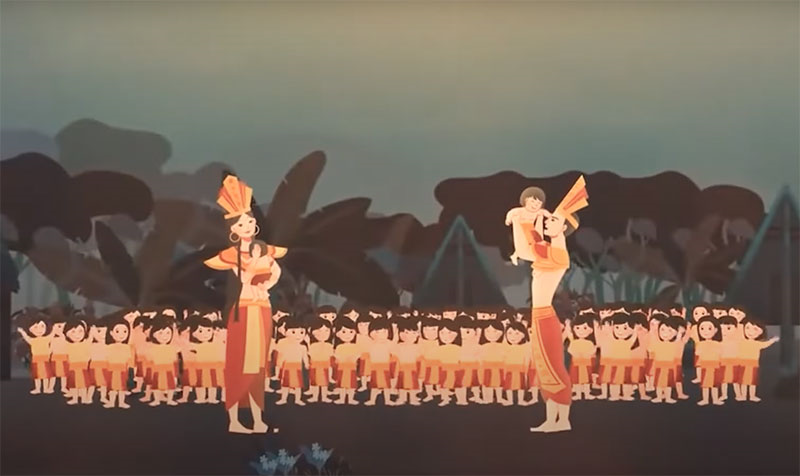
Long ago, before Vietnam had its present name and before its dynasties built capitals along the Red River, there lived a ruler named Lạc Long Quân. He belonged to the realm of water and dragons. He married Âu Cơ, a beautiful woman associated with the mountains and the world of immortals. Their union produced not an ordinary child but a sac containing one hundred eggs. From those eggs came one hundred children.
For a time the family remained together. Eventually, however, Lạc Long Quân told Âu Cơ that they belonged to different worlds. He was descended from dragons and felt at home near the water; she belonged to the mountains. They could not remain together forever. The children were divided between them. Fifty went toward the sea and fifty toward the highlands. In the version of the story most familiar in Vietnam today, the eldest son became a Hùng King, beginning the legendary line of rulers associated with Văn Lang, remembered as the earliest Vietnamese kingdom.
The hundred children became the ancestors of the Vietnamese people.
It is a strange story if approached as a piece of literal history. There are dragons, immortals, miraculous eggs and rulers placed in a time long before reliable written records. Archaeology cannot confirm that a dragon lord married a mountain fairy, nor should a legend be asked to provide evidence it was never created to provide.
But myths survive because they answer questions different from those asked by archaeology.
The story of Lạc Long Quân and Âu Cơ does not tell us exactly when Vietnam began. It tells us how generations of Vietnamese imagined belonging. It connects mountains with sea, families with nations, and people scattered across different landscapes with a single common ancestry. In modern Vietnamese culture, this story remains one of the most powerful ways of expressing the idea that, despite their differences, Vietnamese people come from the same family.
Scholars have shown that the surviving written versions of the founding myth were shaped and reshaped over centuries rather than preserved unchanged from remote antiquity. One of its most important textual homes is Lĩnh Nam chích quái, a medieval collection of Vietnamese legends whose surviving transmission is complicated and includes multiple versions compiled and edited over long periods. A recent study by a specialist in Hán-Nôm textual history emphasizes that the work was associated with the late Trần period but survives through later manuscripts and revisions, making the history of the text itself part of the story.
A Country Between Mountains and Water
Vietnam’s geography gives the legend an almost irresistible logic.
The country occupies a long eastern edge of mainland Southeast Asia, with mountains running through much of its interior and an extensive coastline facing the sea. In northern Vietnam, where the earliest Vietnamese states are traditionally located, the Red River Delta opens toward the Gulf of Tonkin while highlands rise to the north and west. Vietnamese communities developed in landscapes shaped by rivers, monsoon rains, flooded fields, forested mountains and maritime connections.
The union of a being associated with water and another associated with the mountains can therefore be read as more than fantasy. The parents inhabit two fundamental environments of the Vietnamese world.
Lạc Long Quân is usually imagined through the dragon. In East and Southeast Asian traditions, dragons are closely associated with water, rain and cosmic power rather than simply with the fire-breathing monsters familiar from much European folklore. Âu Cơ, meanwhile, belongs to the uplands and to the world of tiên, a Vietnamese term often translated into English as “fairy” or “immortal.” Scholars studying the Hùng Kings myths have pointed out that Âu Cơ’s identity belongs to a wider world of Southeast Asian mythological motifs and that the symbolism attached to her cannot be reduced neatly to the European image of a tiny winged fairy.
The English phrase “Dragon and Fairy” is convenient, but it can also make the story sound more whimsical than it does in Vietnamese.
The dragon represents ancestry, water and power. The immortal belongs to the mountains and another sacred realm. Their descendants inhabit the territory between them.
The family becomes geography.
The Hundred Eggs
The most memorable part of the legend is also its most mysterious.
Âu Cơ does not simply give birth to one hundred babies. In the familiar telling, she produces a sac of one hundred eggs, which hatch into the ancestors of the Vietnamese. The image is so deeply embedded in Vietnamese cultural memory that it appears in schoolbooks, public monuments, paintings, festivals and modern visual representations of national origins.
Why eggs?
There is no single explanation accepted by all scholars. Mythological motifs rarely survive with instruction manuals. Some researchers have connected elements of the story with ancient bird imagery and Southeast Asian traditions. The scholarly study of the Hùng Kings founding narratives notes, for example, interpretations linking Âu Cơ with an immortal or bird-goddess motif, while other theories have explored the importance of bird symbolism in early Việt cultural traditions.
But even without choosing one explanation, the image performs an obvious narrative task.
One womb produces a hundred children.
Difference comes after unity.
The descendants eventually spread across different environments, but they begin enclosed together. Before there is mountain and sea, there is one family. Before there are regions, villages or political divisions, there is one birth.
That symbolism has proved remarkably durable.
Vietnamese people sometimes refer to themselves as con Rồng cháu Tiên, commonly rendered in English as “children of the Dragon and descendants of the Immortal.” Another expression, đồng bào, is even more revealing. Today the term means compatriots or fellow countrymen, but its components are traditionally understood through the image of people sharing the same womb or birth-sac. In popular explanations, the word is repeatedly connected to the hundred children born from Âu Cơ’s miraculous sac.
Whether every element of that linguistic explanation can be traced directly to the ancient legend is less important than the cultural association Vietnamese speakers recognize today. The myth supplies an image for national kinship.
The nation is imagined not first as a territory or government, but as a family whose members emerged together.
Fifty to the Mountains and Fifty to the Sea
Eventually, the perfect family divides.
Lạc Long Quân and Âu Cơ discover that their different natures make permanent life together impossible. Rather than turning the separation into a war, the story divides the children between two environments. Half move toward one parent, half toward the other.
It is tempting to see modern Vietnam on a map and interpret the scene as an ancient explanation for every geographical division in Vietnamese society. That would go too far. Myths accumulate meanings over time, and later readers often see patterns that the earliest storytellers may not have intended.
Still, the imagery is powerful. Vietnamese civilization was never exclusively a civilization of deltas or mountains, farmers or sailors. Communities interacted across ecological zones, and the territory eventually called Vietnam included enormous variation in landscape and ways of life. Modern scholarship has increasingly emphasized Vietnam’s maritime dimensions alongside the more familiar history of its river deltas and agrarian states. A recent Cambridge history of maritime Vietnam itself invokes the Lạc Long Quân story while examining the importance of the sea to early Vietnamese history.
The separation therefore contains a paradox.
The children divide, but the division is precisely what explains their unity.
Those living near the sea remain siblings of those living in the mountains. Distance does not cancel kinship. Different environments produce different lives without producing different origins.
For a country whose history would later include powerful regional distinctions, migrations, territorial expansion and periods of political division, that message became extraordinarily useful.
The Story Has Never Had Only One Version
One of the most interesting things about the legend is something rarely mentioned when it is told to children.
It changed.
Medieval Vietnamese writers did not inherit one frozen text that passed untouched from antiquity to the present. Lĩnh Nam chích quái exists in multiple transmitted versions, and scholars have identified alterations in details, genealogy and moral framing. The collection itself developed through copying and editing, while later historians incorporated founding traditions into historical chronicles.
One example involves Âu Cơ herself. A Hán-Nôm textual study discussed by Vietnam’s Social Sciences Publishing House notes that an older manuscript tradition of Lĩnh Nam chích quái differs from the account later incorporated into Đại Việt sử ký toàn thư, the great fifteenth-century historical chronicle associated with Ngô Sĩ Liên. In the older version discussed by the researcher Nguyễn Thị Oanh, Âu Cơ is connected to Đế Lai as his consort; the later chronicle recasts her as his daughter, a change Nguyễn interprets as reflecting the stronger Confucian moral framework of the later historian.
The fate of the fifty children also shifted. Research published in the Journal of Southeast Asian Studies notes that in one Lĩnh Nam chích quái tradition, fifty sons follow their mother toward Phong Châu. Ngô Sĩ Liên’s later historical version gives the story a more patrilineal shape, associating the sons who establish the Hồng Bàng line with their father.
These differences do not make the legend less valuable.
They make it more revealing.
A myth is not only a message from the distant past. It is also a record of what later societies wanted the past to mean. Medieval Buddhist, local and spirit traditions could leave one kind of imprint. Confucian scholars could impose another. Modern nationalism would add still others.
The legend survived partly because it could change without losing its central idea.
Vietnamese people share an origin.
Where History Begins to Blur
After the separation of the parents, the story moves toward the Hùng Kings.
In the familiar national narrative, the eldest child becomes a Hùng ruler and establishes the dynasty associated with Văn Lang. This legendary era occupies an unusual place in Vietnamese historical consciousness. The Hùng Kings are treated as ancestral founders, yet the world attributed to them belongs to a period where archaeology, later chronicles and myth do not align neatly enough to reconstruct a conventional political history.
Historians therefore distinguish between evidence for ancient societies in the Red River region and the detailed royal genealogies supplied by much later traditions. The scholarly literature on the Hùng myths itself presents competing interpretations of terms such as Hùng, Lạc and Văn Lang and emphasizes the difficulty of treating the narratives as straightforward records of prehistoric rulers.
This distinction matters particularly for foreign readers.
Vietnam undoubtedly has a deep prehistoric past. Archaeological cultures flourished in the region long before Chinese imperial rule, and Bronze Age societies associated with Đông Sơn produced some of Southeast Asia’s most extraordinary metalwork. But it does not follow that every name, reign length and genealogy attributed to the legendary founding age can be read literally.
The temptation to “prove” myths is understandable because nations often want ancient beginnings. Yet myths do not need to be archaeological reports to be historically important.
The question is not merely whether Lạc Long Quân existed.
The question is why Vietnamese writers, rulers and communities repeatedly chose to remember him.
From Family Story to National Story
As Vietnamese political culture developed, the Hùng Kings and their legendary ancestors became increasingly important as symbols of indigenous antiquity.
This mattered in a country that had spent centuries in close political and cultural contact with China. Medieval Vietnamese states borrowed extensively from Chinese institutions, writing, Confucian philosophy and political models, yet they also sought narratives that placed their own realm within an ancient and legitimate past.
The Hồng Bàng genealogy found in Vietnamese founding traditions reached extraordinarily deep into mythological time. The scholarly study of these narratives notes that linking the Vietnamese ancestral line with figures from the wider world of ancient East Asian mythology gave the Việt genealogy an antiquity comparable to prestigious northern traditions.
This does not mean medieval writers simply invented Vietnamese identity from nothing. Rather, they worked with oral traditions, local cults, inherited names, regional mythology and the political needs of their own times.
That is what historical cultures often do.
Rome had Romulus and Remus. Japan developed narratives of divine imperial descent. Korean kingdoms preserved founding myths involving heavenly beings and miraculous births. Across the world, societies have imagined their origins through stories that connect political communities with a sacred past.
Vietnam’s version begins with an impossible family.
And precisely because it is impossible, it can carry meanings that ordinary genealogy cannot.
The Hùng Kings Are Still Worshipped
The story does not survive only on the page.
In Phú Thọ Province northwest of Hanoi, worship of the Hùng Kings remains a major living tradition centered on the ancestral temple complex at Nghĩa Lĩnh Mountain and practiced at numerous related sites. UNESCO inscribed the Worship of Hùng Kings in Phú Thọ on the Representative List of the Intangible Cultural Heritage of Humanity in 2012, describing ceremonies, offerings, pilgrimages and performances that reinforce reverence for ancestors, social cohesion and a sense of national origins.
This is an important distinction.
Foreign visitors may assume that the Hùng Kings belong to the same category as legendary characters encountered only in literature. In Vietnam, they also belong to ritual life.
People travel to temples, burn incense and participate in commemorations. The ancestors of the nation are approached through practices closely resembling the respect paid to ancestors within families. UNESCO explicitly describes the tradition as providing an occasion for people to acknowledge national origins and affirm Vietnamese cultural and moral identity.
The structure should now look familiar.
In a Vietnamese home, descendants gather around an ancestral altar.
At Phú Thọ, the imagined family becomes much larger.
The nation gathers around its ancestors.
A Myth About Difference
There is another reason the hundred children remain powerful in modern Vietnam.
Vietnam is not ethnically or culturally uniform. The country officially recognizes numerous ethnic communities, and even among the Kinh majority there are strong regional identities and variations in accent, cuisine and local custom. Historical experiences in the north, center and south have not always been identical.
The Lạc Long Quân and Âu Cơ story offers a remarkably simple answer to complexity.
You may live in the mountains or near the sea.
You may speak differently.
You may come from another province.
Your ancestors may have followed different paths.
But the children began together.
One should be cautious about forcing a medieval myth into contemporary ideas of multicultural citizenship. The historical relationship between Việt state expansion and the many communities incorporated into modern Vietnam is far more complicated than a story about one hundred siblings can capture. A founding myth can inspire unity while also simplifying histories that deserve to remain complicated.
Yet this is precisely why myths are worth studying critically rather than merely repeating reverently.
They reveal the ideals a society wishes to project.
The Lạc Long Quân and Âu Cơ story imagines difference without complete separation. Its people scatter but remain related. Geography divides them without destroying their common origin.
In that sense, it is not really a story about where Vietnamese people came from.
It is a story about why they should still consider one another family.
Dragon Children in a Modern Country
The imagery remains surprisingly alive in a society of smartphones, apartment towers and global supply chains.
References to con Rồng cháu Tiên appear in education, public ceremonies, literature, journalism and cultural art. Artists continue to reinterpret the hundred eggs and the ancestral parents. Festivals associated with Lạc Long Quân, Âu Cơ and the Hùng Kings remain active, while contemporary monuments turn the myth into stone, bronze and large-scale public imagery. In 2026, for example, cultural events and new artworks connected with Lạc Long Quân and Âu Cơ continued to present the legend explicitly as a story of national origins.
Its survival tells us something about modernization in Vietnam.
Modernity has not required Vietnamese people to choose between skyscrapers and ancestors. Old stories can move into new media. Ancient figures appear in animation. Legendary kings are represented in museums. Traditional festivals are filmed by smartphones. Schoolchildren encounter narratives first recorded in medieval manuscripts through digital screens.
The form changes.
The need for origins does not.
The Truth Inside a Myth
There is a habit, particularly in modern historical writing, of placing stories into two boxes.
True or false.
History or legend.
Fact or fiction.
These distinctions are essential when reconstructing the past. We should not date prehistoric kingdoms by accepting miraculous genealogies as literal evidence, nor should historians transform poetry into archaeology.
But there is another kind of truth.
The story of Lạc Long Quân and Âu Cơ is true in the sense that Vietnamese people have told it, preserved it, rewritten it, taught it, represented it and built rituals of belonging around the world it creates. The surviving texts show that its details were transformed by generations of writers. The living worship of the Hùng Kings shows that the ancestral imagination attached to that world remains culturally significant today.
A myth can therefore tell us something that a list of prehistoric dates cannot.
It tells us how people want to be related to their past.
For Vietnam, that relationship begins with a family divided between two landscapes. The father moves toward water. The mother moves toward mountains. Their children follow different paths, carrying the same origin with them.
Centuries of actual Vietnamese history would be far more turbulent. Kingdoms would rise and fall. Armies would cross borders. People would migrate southward. Villages would develop distinct customs. Regions would fight one another. Foreign empires would intervene. Modern political divisions would separate families far more painfully than any mythical farewell between dragon and immortal.
Yet the old story continued to insist on something simpler.
Before the divisions, there was one family.
That may be why it survived.
When Vietnamese people call themselves descendants of Dragon and Fairy, they are not making a claim that belongs to genetics. They are invoking a memory older than any living family, a symbolic ancestry spacious enough to include mountains and sea, myth and history, separation and reunion.
Some nations begin their stories with a battle.
Vietnam begins one of its oldest and most beloved stories with a birth.